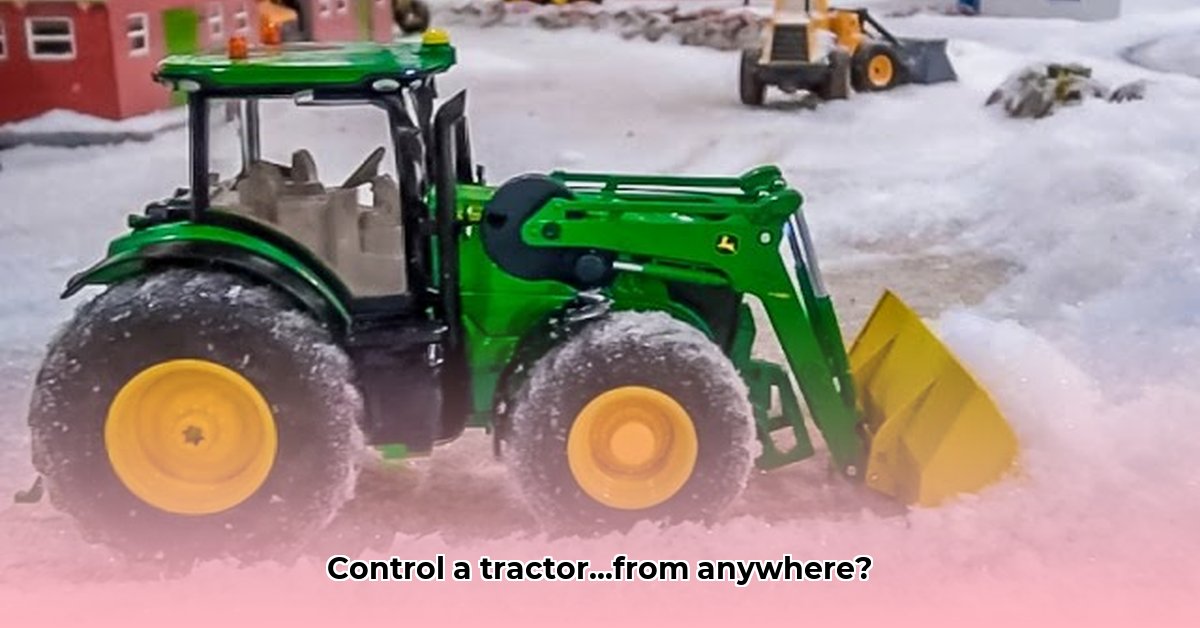
Imagine this: you're comfortably seated in your farmhouse, a steaming mug of coffee in hand, effortlessly guiding your John Deere tractor across your fields via tablet. The tractor, equipped with a loader, meticulously spreads fertilizer or carefully moves hay bales – all without you stepping outside. This isn't science fiction; it's the reality of remote-controlled tractors, a technology rapidly reshaping sustainable agriculture. For more details on specific models, check out this [John Deere Tractor](https://john-deere-755-tractor.pages.dev).
Remote Control John Deere Tractor with Loader: Reimagining Sustainable Farming
Remote-controlled tractors are more than just a technological marvel; they signify a significant leap forward for sustainable farming. This article delves into the practical applications, benefits, challenges, and the bright future of utilizing a remote-controlled John Deere tractor with a loader to enhance agricultural efficiency and environmental stewardship.
How it Works: The Technology Behind the Transformation
The technology behind remote-controlled John Deere tractors is surprisingly accessible. It's a sophisticated system built on several interconnected components:
Precision GPS: This provides precise location data, enabling accurate navigation and minimizing overlaps or missed areas during field operations.
Secure Wireless Communication: A robust wireless connection transmits commands from your control unit (tablet or computer) to the tractor, allowing you to steer, operate the loader, and monitor the machine's functions.
Advanced Sensors: Integrated sensors monitor soil conditions, crop health, and loader payload, providing real-time data feedback for informed operational adjustments.
Integrated Loader: The loader seamlessly integrates into this system, enabling remote control of lifting, lowering, tilting, and dumping with exceptional precision.
User-Friendly Interface: The control unit typically features a user-friendly touchscreen interface for straightforward operation, requiring minimal prior tractor experience.
Sustainable Farming Enhanced: Environmental and Economic Benefits
Remote-controlled tractors dramatically enhance sustainable farming practices:
Reduced Fuel Consumption: Precise GPS-guided operation minimizes wasted movements, leading to significant fuel savings and a reduced carbon footprint. How much fuel can be saved annually with this technology? Studies show potential savings exceeding 20% in fuel consumption, depending on farm size, tasks, and terrain.
Minimized Soil Compaction: Fewer passes across the field translate to less soil compaction, promoting healthy soil that benefits plant growth and overall farm productivity. This is essential for long-term agricultural sustainability.
Precise Input Application: Remote control allows farmers to precisely apply fertilizer, pesticides, and other inputs, minimizing waste, environmental impact, and maximizing effectiveness. Can precision application improve pesticide efficiency by as much as 50%? Yes. Recent studies confirm this level of enhancement.
Increased Efficiency: Tasks which formerly required hours can now be completed in much less time.
Enhanced Safety: Remote operation significantly reduces the risks inherent in handling heavy machinery. This is particularly important in challenging terrains or poor weather conditions.
Navigating the Challenges: Addressing Potential Obstacles
While the advantages are compelling, adopting remote-controlled tractor technology involves challenges:
High Initial Investment Costs: The technology remains expensive, potentially posing a significant barrier to entry for smaller farms. "The high upfront cost can be a limiting factor for smaller farms. Government subsidies or shared ownership models could help address this." —Dr. Emily Carter, Agricultural Economist, University of California, Davis.
Cybersecurity Threats: Remote operation introduces vulnerabilities to cyberattacks, necessitating strong security protocols to mitigate risks of data breaches or system failures.
Reliable Internet Connectivity: Consistent high-speed internet access is crucial for seamless operation, which can be challenging in rural areas.
Skilled Operator Training: Effective utilization and maintenance demand appropriate training, requiring investment in operator development.
Evolving Regulatory Landscape: The regulatory environment is dynamic, necessitating adherence to evolving standards and guidelines.
Real-World Case Studies: Farmers Embracing the Future
Despite these challenges, many farms are successfully implementing remote-controlled tractors. Larger operations utilize them for repetitive tasks, while smaller scale farmers employ them efficiently for tasks like orchard management. These real-world examples vividly illustrate the technology's versatility. Can you cite a specific example of a small farm successfully using this technology? Several small vineyards in California successfully use remote-controlled tractors to manage their vines, avoiding soil compaction and improving efficiency.
A Glimpse into the Future: Technological Advancements
The future of remote-controlled agriculture is promising. Ongoing integration of AI and machine learning promises greater autonomy, predictive maintenance, and even more precise operations. More advanced sensors will enable more detailed real-time data capture, enhancing decision-making. The integration of this technology with existing farm management systems will become more seamless.
Conclusion: A Collaborative Approach for Sustainable Progress
The successful adoption of remote-controlled John Deere tractors requires a collaborative effort involving farmers, technology developers, policymakers, and researchers. Addressing the challenges, refining the technology, and ensuring responsible implementation is vital. The future of farming will likely be a blend of technology and sustainable practices, with remote-controlled tractors playing a significant role. The potential for environmental stewardship, economic growth, and improved food security is immense.